
1 Pages (10 items)
need help - Messages
#1 Posted: 5/9/2026 8:35:16 AM

Hello,
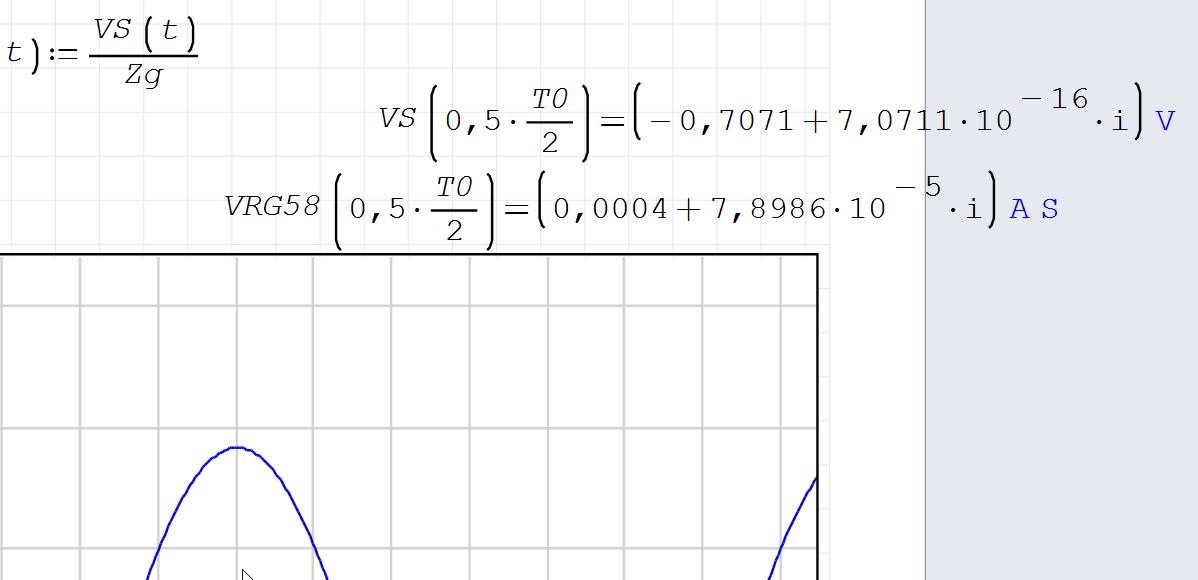
unfortunately, I can't find the error myself. Why VS(t) and VRG58(t) work well, but V1(t):=VS(t)-VRG58(t) not?
Regards Andreas
Auszug.pdf (114.69 KiB) downloaded 244 time(s).
Auszug.sm (16.52 KiB) downloaded 325 time(s).
unfortunately, I can't find the error myself. Why VS(t) and VRG58(t) work well, but V1(t):=VS(t)-VRG58(t) not?
Regards Andreas
Auszug.pdf (114.69 KiB) downloaded 244 time(s).
Auszug.sm (16.52 KiB) downloaded 325 time(s).
#2 Posted: 5/9/2026 9:14:00 AM

It seems that the two quantities have different units of measurement.
sergio
sergio
#3 Posted: 5/9/2026 12:44:41 PM
Thanks Sergio,
wrong was VRG58(t):=Ig(t)*(1/ZLRG58+1/RRG58)
right is VRG58(t):=Ig(t)*(ZLRG58+RRG58)
Regards Andreas
wrong was VRG58(t):=Ig(t)*(1/ZLRG58+1/RRG58)
right is VRG58(t):=Ig(t)*(ZLRG58+RRG58)
Regards Andreas
#4 Posted: 5/10/2026 5:52:13 AM
Hello,
and here’s another problem. Why does the differential of V1(t) work, but not that of V2(t)?
Both are sine functions; later, I’d like to try using square-wave functions as input as well.
For V1 and V2, I need the peak-to-peak amplitude and the phase difference between the two. I want to see if I can get better approximations for determining C1 by taking RG58 and the probe tip’s internal resistance into account in the measurement results.
Regards Andreas
Translation of “Der Wert ist oberhalb der maximalen Grenze für positive Zahlen” = “The value is above the maximum limit for positive numbers”
Versuch mit R und C mit Oszi.pdf (982.36 KiB) downloaded 222 time(s).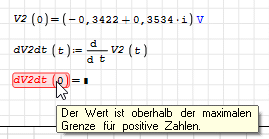 Versuch mit R und C mit Oszi.sm (131.13 KiB) downloaded 323 time(s).
and here’s another problem. Why does the differential of V1(t) work, but not that of V2(t)?
Both are sine functions; later, I’d like to try using square-wave functions as input as well.
For V1 and V2, I need the peak-to-peak amplitude and the phase difference between the two. I want to see if I can get better approximations for determining C1 by taking RG58 and the probe tip’s internal resistance into account in the measurement results.
Regards Andreas
Translation of “Der Wert ist oberhalb der maximalen Grenze für positive Zahlen” = “The value is above the maximum limit for positive numbers”
Versuch mit R und C mit Oszi.pdf (982.36 KiB) downloaded 222 time(s).
Versuch mit R und C mit Oszi.sm (131.13 KiB) downloaded 323 time(s).Edited 5/10/2026 6:01:03 AM
#5 Posted: 5/10/2026 8:15:12 AM
"Why does the differential of V1(t) work, but not that of V2(t)?"
It's a combination of the size of the numbers and the order in which SMath does its calculations. Try:

It's a combination of the size of the numbers and the order in which SMath does its calculations. Try:
#6 Posted: 5/10/2026 10:41:34 AM
Yeah, that's how it works for me, too.
#7 Posted: 5/12/2026 1:09:32 PM
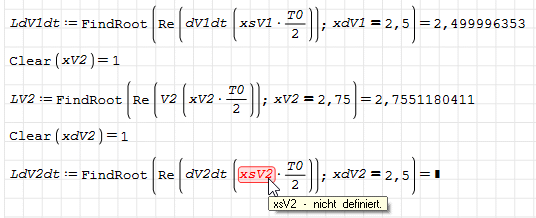
It's me again, with a new problem.
Why doesn't the last line work, when the four lines above it do?
 Versuch mit R und C mit Oszi Auszug.pdf (910.43 KiB) downloaded 222 time(s). Versuch mit R und C mit Oszi Auszug.sm (130.35 KiB) downloaded 306 time(s).
Why doesn't the last line work, when the four lines above it do?
Versuch mit R und C mit Oszi Auszug.pdf (910.43 KiB) downloaded 222 time(s). Versuch mit R und C mit Oszi Auszug.sm (130.35 KiB) downloaded 306 time(s).
#8 Posted: 5/13/2026 2:13:04 AM
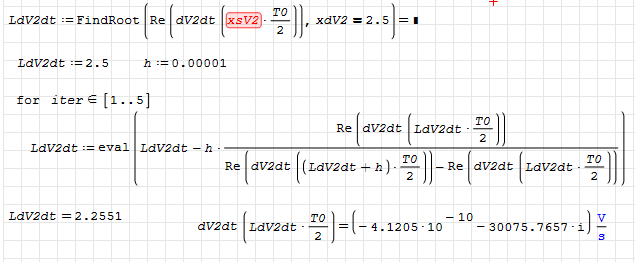
Hi. I have no idea why it fails, however this may be a workaround, consisting of directly applying the Newton-Raphson method.
Versuch mit R und C mit Oszi Auszug.sm (121.16 KiB) downloaded 283 time(s).
Best regards.
Alvaro.
Versuch mit R und C mit Oszi Auszug.sm (121.16 KiB) downloaded 283 time(s).
Best regards.
Alvaro.
#9 Posted: 5/13/2026 5:47:01 AM
And why can I only use the values for LV1 and LV2 once, but the values for LdV1dt and LdV2dt multiple times?
I had already deleted the `clear()` statements, but that wasn't the problem.
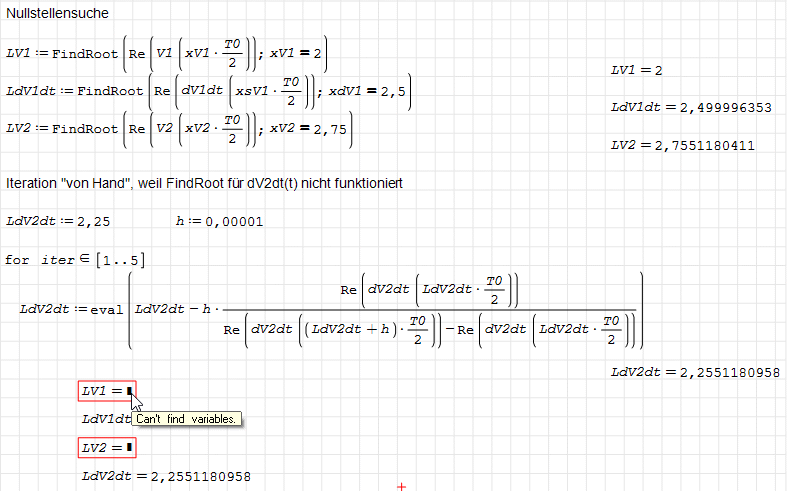
I had already deleted the `clear()` statements, but that wasn't the problem.
Edited 5/13/2026 5:48:52 AM

1 Pages (10 items)
- New Posts
- No New Posts